
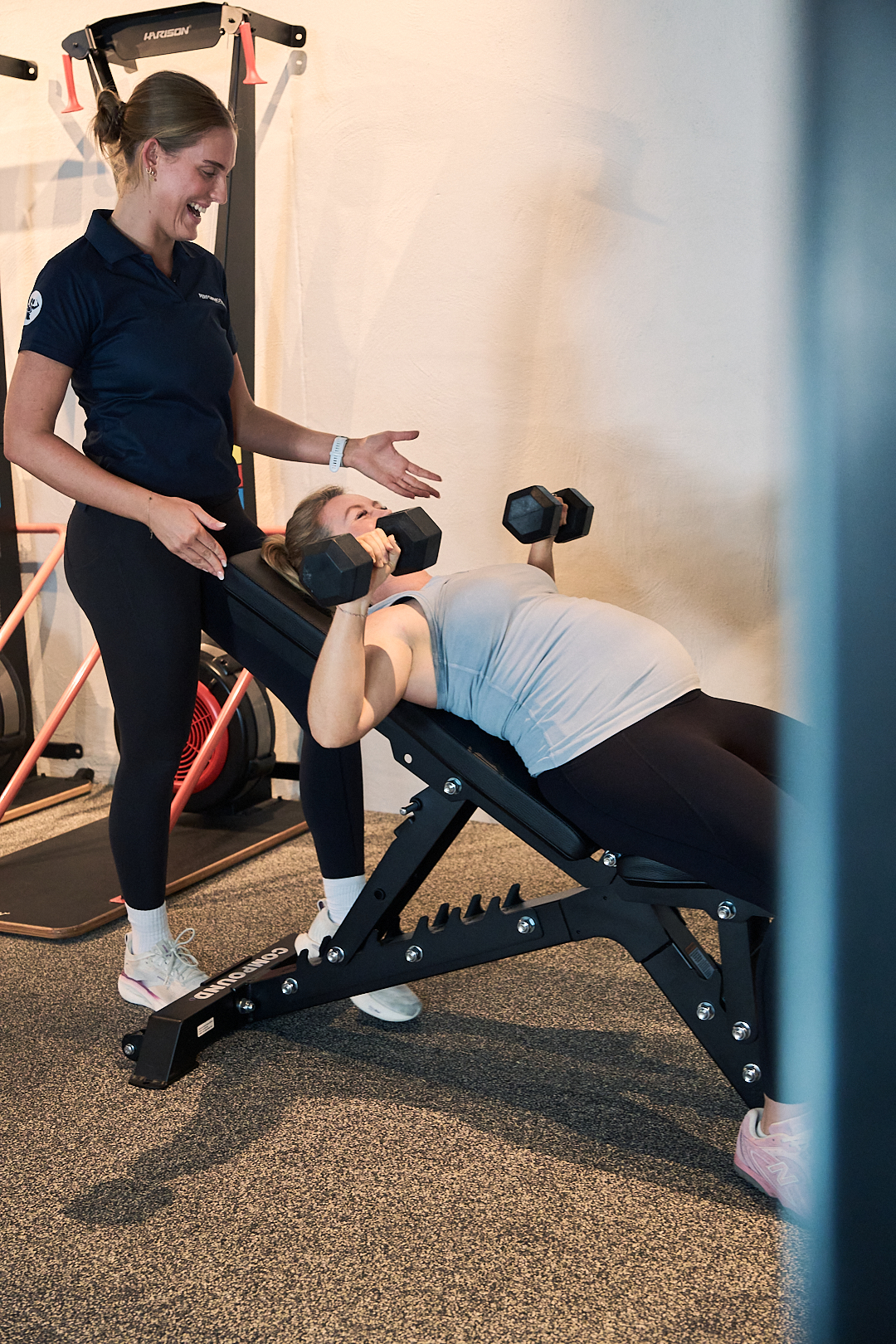
This is part two of our series on heavy lifting in pregnancy. If you missed part one, you can find it here.
Trimester 2 (Weeks 14-27):
What’s Happening
For many women the second trimester brings a welcome shift. Energy often improves, nausea tends to settle and the bump is growing but not yet significantly impacting movement. Blood volume continues to increase and cardiac output rises to support your growing baby.
What the Research Tells Us
The evidence base for resistance training in the second trimester is strong. Prevett et al.’s 2025 meta-analysis found no increase in adverse maternal or fetal outcomes even at higher training loads. A 2023 prospective study by Prevett, Kimber, Forner, de Vivo and Davenport (International Urogynecology Journal) surveyed nearly 700 pregnant women in heavy resistance training including Olympic lifting and found perinatal outcomes and pelvic floor health were not meaningfully altered by whether women engaged in or avoided Olympic lifting, the Valsalva manoeuvre or supine lifting. Importantly, women who maintained pre-pregnancy training levels until delivery reported fewer reproductive complications than those who stopped earlier – that’s not a small finding.
Things Worth Knowing as Your Body Changes
- Supine positioning: The caution around lying on your back stems from the uterus potentially compressing the inferior vena cava – but this concern was built around prolonged motionless rest, not exercise. Dalhaug et al. (2025) found no adverse changes in fetal blood flow during bench press in pregnant athletes and Prevett et al. (2023) found 71% of nearly 700 pregnant heavy lifters trained supine throughout pregnancy with typical outcomes. The evidence is more reassuring than many women expect and we’ll explore this in depth in a dedicated blog on bench pressing during pregnancy. In the meantime a women’s health Exercise Physiologist can help you navigate this on an individual symptom-guided basis.
- Balance and centre of gravity: Your centre of gravity is shifting which can affect how certain movements feel. It’s worth listening to that.
- Pelvic floor awareness: As intra-abdominal pressure increases with load it’s a good time to check in with how your pelvic floor is responding. Sensations of heaviness, pressure or leaking are useful information – a Pelvic Floor Physiotherapist alongside your women’s health Exercise Physiologist means you have a team looking at the whole picture.
- Load: The research doesn’t support a universal weight limit during pregnancy. What matters more is how your body is responding and having the right team around you to help make those calls with confidence.
Trimester 3 (Weeks 28-40): The Evidence Might Surprise You
What’s Happening
The third trimester tends to attract the most caution – from healthcare providers, family and the internet. And while there are real physiological changes to be aware of, the evidence tells a more nuanced and often more reassuring story than many people expect.
What the Research Tells Us
Beetham et al.’s 2019 systematic review and meta-analysis (BMC Pregnancy and Childbirth) brought together 15 studies involving over 32,000 participants and found that vigorous intensity exercise into the third trimester was associated with:
- No significant difference in birth weight compared to those who were less active
- No increased risk of small for gestational age or low birth weight
- A small but significant increase in gestational age at delivery (+0.21 weeks)
- A small but significantly reduced risk of preterm delivery
Third trimester vigorous exercise was associated with slightly longer pregnancies and a reduced risk of prematurity – that’s a significant finding.
Dalhaug, Sanda, Bø, Brown and Haakstad (2025) published in BMJ Open Sport and Exercise Medicine followed 48 healthy pregnant athletes completing 3×8 repetitions of sumo deadlift, bench press and incline bench press at one repetition in reserve. No major adverse changes in fetal heart rate or umbilical artery blood flow were observed and the Valsalva manoeuvre did not appear to compromise fetal blood flow in this well-trained population. The emerging research is beginning to challenge some long-held assumptions and working with a women’s health Exercise Physiologist means you have someone across this evolving evidence base who can apply it to your individual situation.
Things Worth Being Aware of in Trimester 3
- Supine modifications: Many women find longer periods flat on their back become uncomfortable in the third trimester and the body tends to give clear signals. Incline variations are a natural and well-supported adaptation.
- Breathing during lifting: Conversations around the Valsalva manoeuvre are evolving and the evidence for blanket avoidance in trained individuals is less clear than it once seemed. Working with a women’s health Exercise Physiologist and Pelvic Floor Physiotherapist to find a breathing strategy specific to how you train is a much more individualised and effective approach.
- Technique adaptations: Load doesn’t necessarily need to decrease but how movements feel will change. Stance, grip and range of motion may all shift naturally – and that’s completely normal. Having someone guide you through those adaptations makes a real difference.
- Pelvic floor symptoms: Any leaking, feelings of heaviness or pressure or pelvic pain during or after lifting is worth exploring – not as a reason to stop but as information that a Pelvic Floor Physiotherapist can help you make sense of in collaboration with your Exercise Physiologist.
- Knowing when to check in with your care team: Symptoms like unusual breathlessness, chest discomfort, vaginal bleeding, a severe headache or any changes in fetal movement during or after exercise are always worth a prompt conversation with your midwife or obstetrician.
In the next blog we’ll be taking a deeper look at powerlifting and competitive strength training during pregnancy – including what the research says about occupational loads, the Valsalva manoeuvre and what training might look like for high performance athletes.
Written by Annie Daly, Senior Exercise Physiologist
References:
Prevett C, Gingerich J, Sivak A, Davenport MH. Resistance training in pregnancy: systematic review and meta-analysis of pregnancy, delivery, fetal and pelvic floor outcomes and call to action. British Journal of Sports Medicine. 2025;59(16):1173. doi:10.1136/bjsports-2024-109123
Prevett C, Kimber ML, Forner L, de Vivo M and Davenport MH. Impact of heavy resistance training on pregnancy and postpartum health outcomes. International Urogynecology Journal. 2023;34(2):405-411. doi:10.1007/s00192-022-05393-1
Dalhaug EM, Sanda B, Bø K, Brown W and Haakstad LAH. Pushing limits: the acute effects of a heavy-load resistance protocol and supine exercise on fetal well-being. BMJ Open Sport and Exercise Medicine. 2025;11(3):e002639. doi:10.1136/bmjsem-2025-002639
Beetham KS, Giles C, Noetel M, Clifton V, Jones JC and Naughton G. The effects of vigorous intensity exercise in the third trimester of pregnancy: a systematic review and meta-analysis. BMC Pregnancy and Childbirth. 2019;19:281. doi:10.1186/s12884-019-2441-1