The key to improving your performance
When training, we almost always hear of training cardio and how beneficial it is to train BUT what if I told you that there is a quicker and less fatiguing way of getting a similar result?
Let me introduce you to training your anaerobic system!
To make things super digestible, the anaerobic system is basically used for any form of training that lasts less than 5 minutes. So this means all efforts lifting weights, MOST running events (shorter distances around 1km and less), and the really fun high intensity effort events.
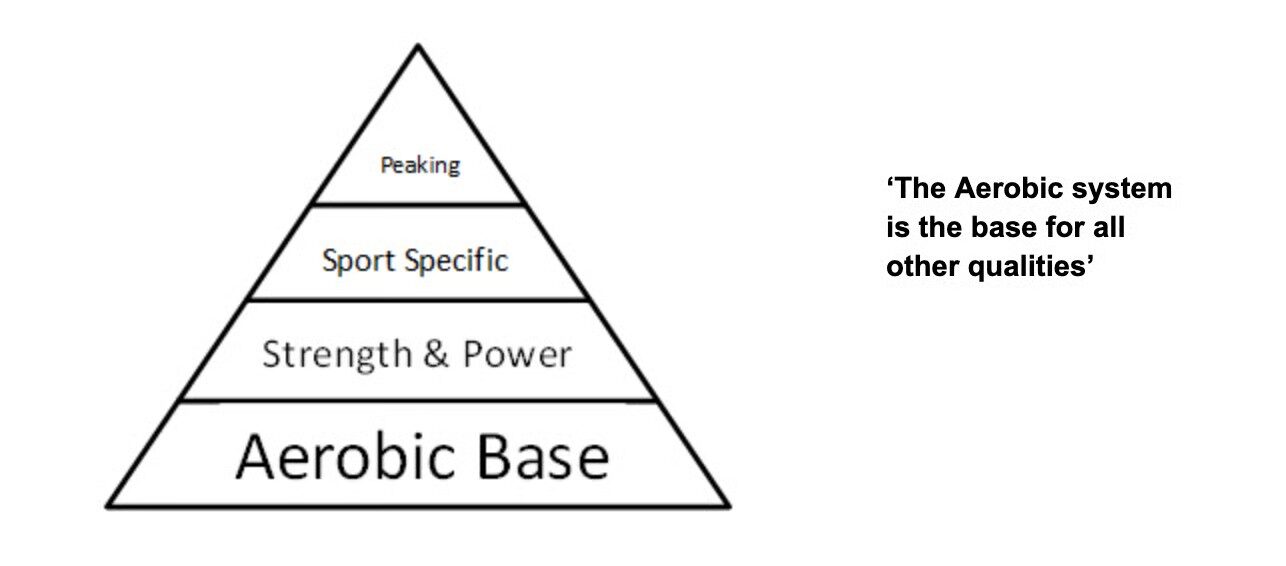
The beautiful thing about integrating some form of anaerobic/aerobic training into your life means that we can increase our base level of fitness. Think of increasing your aerobic baseline as the bottom of the pyramid, if this base is big and strong then we can build up all other traits from this solid base.
This means that we are able to increase our total amount of work done, improve our recovery between sessions or even in between sets, and not get tired/out of breath doing daily tasks (like going up stairs or walking for long periods)…
How does it work?
This almost sounds too good to be true, doing short amounts of anaerobic work, increasing your fitness base, and not impacting your training?!
Essentially, we need to be doing short ‘sprint’ efforts that really push your ability to create some form of adaptation. This adaptation comes from working above your ‘comfortable’ level of aerobic ability (usually a pace you can hold for a long time).
By working above 100% of your aerobic capacity, we are basically forcing your body to get fitter with these short exposures. Over time with more and more gradual exposures, we are able to see a pretty decent increase in fitness without having to go and do any long runs for cardio.
An example of this would be something like sprints on an assault bike. You probably wouldn’t be able to do a whole lot of them in a row because of how high the effort is. Though if we were to stagger them into sets and reps then we would be able to spend more time above 100%, forcing our body to gradually get fitter.
What does it look like?
So now we have a rough idea as to how anaerobic training works, what would this look like if we wanted to integrate it into our training week?
For anaerobic training you want to be able to target high intensity, repeatable efforts that are above 100% of your aerobic capacity. One of the simplest ways that we can do this is by using short sprint style activities that tick the boxes we need. This will be different for those that run as a part of their sports, though integrating this as someone who just lifts weights is a great way to move outside of going down and up with a barbell.
Depending on what you have access to there are a few different approaches you can take. I’ll give an example for weights, riding, and running to cover as many bases as possible.
Weights:
This is where we can look to integrate the trending ‘hybrid’ style of training. This is probably for most barbell sport athletes, the second most fatiguing style of anaerobic training. I say this as we are typically already training our muscles so much that it would add more fatigue to similar areas. My recommendation for this would be starting with an easy circuit style of training, that includes movements that are out of your normal ranges of movement.
An example of this would be:
6 rounds as fast as possible
Bicep curl to overhead press x15
Mountain climbers x20 (10 each side)
Jump squats x12
Close grip push ups x12
Burpee box jump x6
Rowing/assault bike:
This is probably the least invasive of the 4 options that Ill go through. This and the rower are usually the quickest anaerobic efforts to get through and as a result we can often do more of them throughout the week. For this protocol in particular we want to go for a max of 12 weeks so that we don’t have too much bleeding into our normal training. You will want to build up to 3 sets after 2-3 weeks of doing this.
An example of this is:
Start with 2 sets, 6 reps. 2-3 Min rest between sets.
6 second sprint 9 second rest between reps. (Total time – inc. rest = approx 6min)
Build to 3 sets, 8 reps. 2-3 Min rest between sets.
6 second sprint 9 second rest between reps. (Total time – inc. rest = approx 14min)
Running:
Unless you are conditioned to running, this is going to be the most fatiguing of the four options. Running is one thing, being efficient at running is a whole different ball game. For running we want to keep prescription super simple and easy to implement.
This looks like, simple, straight line running at a high intensity to keep duration low, and effort high. You can start with one session per week and if you’re not feeling it bleed into your other training too much then you can introduce another session.
An example of this is:
Straight line running, 30 seconds of running (non-stop sprinting essentially), 30 seconds of rest (static rest or walking). Repeat for 4 efforts, rest 2min then repeat.
Total working time 10min (including between set rest).
Will it affect my weight training?
This wont necessarily have a negative impact on your training if done correctly. There are a few things that you will need to monitor post anaerobic effort going into your next session like
- How recovered are you?
- Is there an excessive amount of soreness?
- Do you feel more tired than normal?
- Did your normal training feel hard?
If you can answer these questions and reply with confidence that you’re not having this anaerobic training bleed into your sessions making them harder, then it’s a good sign that you can continue it.
We should see a positive impact over a 4-6 week period with improvements in fitness, recoverability, and intraset recovery!
If you’re keen to include some of this training into your program but are unsure as to how to do it then please feel free to reach out to one of our expert exercise physiologists to guide you in the right direction!