
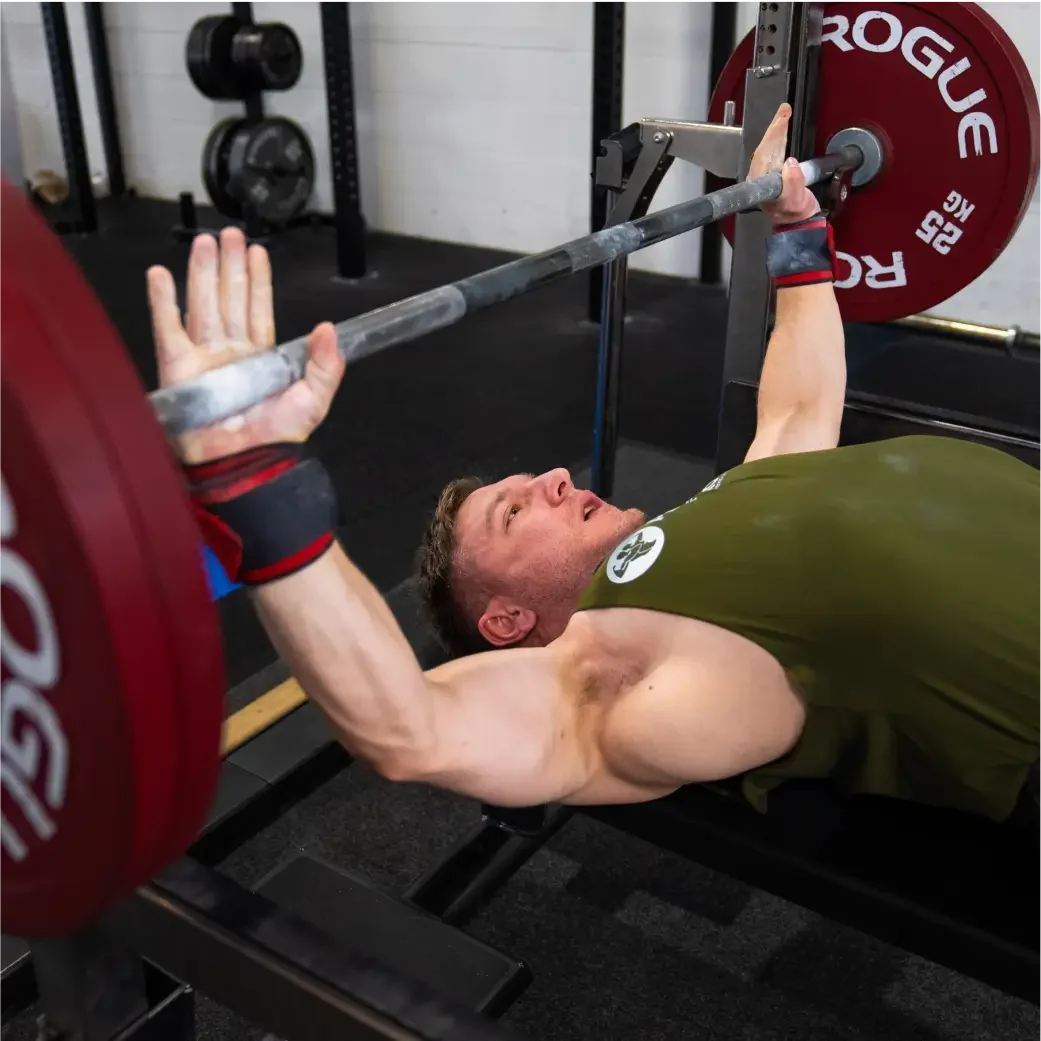
When people think of pressing exercises (bench press, push-ups, machine chest presses), the first thing that comes to mind is pec development. And rightly so. The pectoralis major plays a huge role in horizontal pressing. But there’s a commonly overlooked piece of the puzzle when it comes to really getting the most out of your pecs: humeral adduction.
Let’s break that down.
One of the pec’s key functions: humeral adduction
The pec major doesn’t just help push things forward, it also brings the arm closer to the midline of the body. That’s humeral adduction. In pressing exercises, we can bias this function by cueing and setting up movements so the upper arm sweeps inward across the torso, not just straight forward.
Some people try to do this by adjusting their pressing angle, or more typically by using fly-like variations. That’s great in theory, but there’s one big thing many people miss that limits how well this works.
The missing link: scapular control
The shoulder blade (scapula) is the base of the entire shoulder joint, and its position massively influences how well the humerus (upper arm bone) can move. In pressing, especially when people are trying to bias the pecs through adduction, there’s a tendency for the scapula to protract, or round forward.
And that’s where things go wrong.
When the scapula rounds forward too much, the entire shoulder complex moves toward the midline. That means the pec’s attachment point on the humerus is no longer moving relative to its origin on the sternum. It’s just moving everything together.
This reduces the relative motion that creates true humeral adduction. In other words, you’re not getting as much pec shortening as you think.
The fix: keep the scapula anchored (mostly)
To get real humeral adduction, the scapula has to stay relatively stable. That doesn’t mean pinned back entirely, it means controlled and supported. You want the scapula to allow movement at the shoulder joint without stealing range by shifting forward itself.
A good cue or setup might be:
- “Reach with the arm, not from the shoulder blade.”
- Use cable or machine fly variations where you can focus on arm path without needing scapular protraction for stability.
- Think solely about moving the arm across the body.
Bottom line
If you’re trying to bias your pecs by training their adduction function, make sure you’re not sabotaging the movement by letting your shoulder blade do all the work. Anchor the scapula, control your fly path, and make sure the humerus is actually sweeping toward the midline relative to a stable base.
Your pecs will thank you for it. Not sure if your setup is doing this? It’s exactly what video review in our online coaching picks up.
Get your technique reviewed
Video review catches exactly this kind of fixable technique gap.